
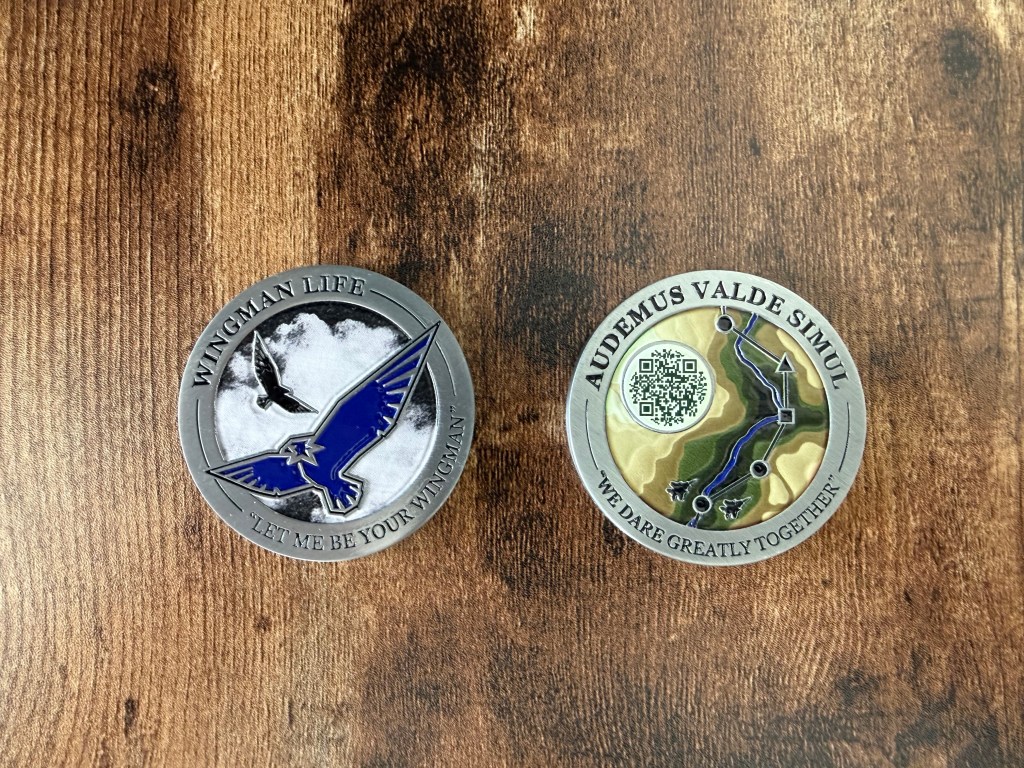
The story of the military challenge coin tradition in U.S. Air Force fighter squadrons
The challenge coin tradition is part history, part folklore, and part living squadron culture. The most commonly told origin story traces the tradition to early military aviation: a pilot carried a small medallion bearing his flying squadron’s insignia, was shot down, escaped captivity, and used the medallion to prove his identity to friendly forces. Versions of the story differ on whether this happened in World War I or World War II, and official military sources acknowledge that the exact origin of the tradition is unclear. What matters culturally is the story’s moral: the coin represented proof of where the pilot belonged.
In current Air Force practice, challenge coins are small, custom-made, metallic emblems of a commander, unit, mission, aircraft, deployment, or achievement. They are both symbols of membership and tools for recognizing excellence, honoring service, and enhancing morale. In any case, they are never merely souvenirs. They say, in physical form: “You are recognized as an integral part of this team or a key supporter of our mission.”
The most meaningful coin presentations are often quiet ones with no fanfare. A commander, flight lead, instructor, weapons officer, or other respected leader or teammate will simply palm a coin during a handshake, to give it to someone who performed well, solved a difficult problem, showed courage, took special care of the team, or represented the team well. The coin becomes a story each recipient can hold and keep in their pocket.
In fighter squadrons, the challenge coin tradition carries extra emotional force because squadron identity is unusually strong. Fighter squadrons thrive on shared symbology and mythology, including unique patches, callsigns, aircraft tail flashes, rituals, and stories about deployments and mishaps, victories and losses – cultural artifacts and practices that say, “This is who we are.” A squadron coin fits naturally into that world. It becomes a pocket-sized squadron patch suitable for any occasion: substantial but portable, durable and significant.
Among fighter pilots, the unreasonable but standard expectation is that, at all times for the rest of their lives, they will carry each and every squadron coin they earn during their careers, to be prepared 24/7/365, if they are ever challenged by anyone. If someone produces a squadron coin as a challenge to a squadronmate and they cannot counter the challenge, the empty-handed person must buy the next round of drinks, even though the challenge is less about drinks and more about belonging, loyalty, readiness, and the camaraderie that comes with shared memories of challenges endured and overcome together.
The fighter squadron version of earning a coin is not just: “Here is a token of appreciation.” It is closer to a litany:
- You met the standard.
- You are one of us.
- The rest of us can count on you.
- Now carry this coin for the rest of your life – to help you remember what you accomplished as a member of this team, and the wingmen who flew beside you.
The story of my Wingman Executive Coaching challenge coin
In Air Force culture, the “wingman” concept has both a tactical and a cultural meaning.
Tactically, a wingman supports their flight lead and the rest of their formation on each mission they execute together by:
- “Flying the briefed position” – Being where they’re expected to be
- “Being on frequency” – Listening carefully and with interest to everything said by everyone else
- “Communicating clearly, concisely, and correctly” – Adding to the conversation when they speak
- “Flying heads up and eyes out” – Being present and paying attention
- “Staying ahead of the jet” – Anticipating next steps
- “Checking six” – Watching for threats
- “Executing the contract” – Doing their job
- “Calling it early” – Owning their mistakes
Culturally, the Air Force has broadened the wingman term into a world-class standard of committed mutual support that applies outside as much as inside the cockpit, among pilots and non-pilots alike, in every situation where we find ourselves with a shared challenge – and, in a wingman culture, all challenges are expected to be shared.
In keeping with that culture of mutual support, my offer to my coaching clients, my colleagues, my friends, and my family members is, “Let me be your wingman.”
I am saying:
- You do not have to lead or live alone.
- I will fly in formation with you, regardless of the challenges you face.
- I will watch your blind spots.
- I will tell you the truth.
- I will help you stay mission-focused under pressure.
- I am committed to your success.
As a coach, colleague, friend, and family member wingman, I am not the flight lead or the pilot-in-command. Instead, I am committed to flying alongside others, observing, supporting, challenging, and debriefing them, so that they can become better decisionmakers, leaders, and overall human beings.
In fighter squadrons, a challenge coin is a symbol of belonging, loyalty, readiness, and camaraderie. I created my Wingman Executive Coaching challenge coin in that same spirit.
I present my coin as a request that you “Let me be your wingman.” That means that you have the lead — but you do not have to fly alone.
That first request comes with a second, that you would also be my wingman. So that we can dare greatly together: Audemus Valde Simul.
When we say yes to one another in this way, we are living what I call “Wingman Life.”
Wingman Life makes me grateful and excited to “kick the tires and light the fires” with my wingmen every single new day.
I want to be able to say not, “There I was…,” but “There we were” – because new adventures await, and adventures are always better with wingmen.


 Wingman Executive Coaching
Please leave a comment!