
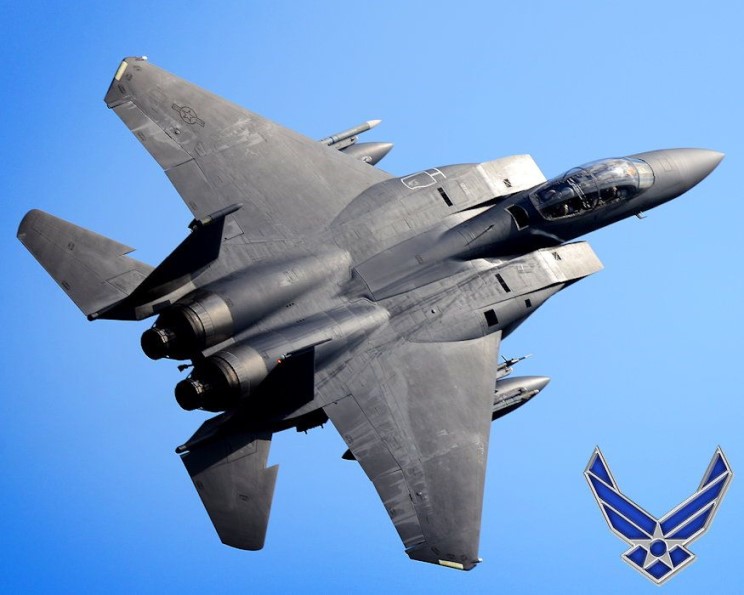
There I was… with this beautiful jet’s planform about to come under my gunsight pipper in my heads-up display.
As Maverick would put it, “He’s too close for missiles, Goose. I’m switching to guns.” Except, if you’re too close for missiles, and you take the time to say something – especially something as wordy as that memorable line from Maverick – you’re going to fly right past your chance to shoot your adversary and then out in front of your adversary’s gunsight instead.
For the record, the silly Top Gun dialogue in this case and many others has no bearing at all on the number of times I’ve watched both Top Gun films, which is inordinate. But back to the teammates I almost killed.
“There are No Points for Second Place”
I was a U.S. Air Force instructor pilot in the F-15E Strike Eagle training unit, and I was leading a Basic Fighter Maneuvers (BFM) requalification sortie for a pilot and a Weapon Systems Officer (WSO, pronounced “Wizzo”), both of whom were happily returning to F-15E flight duty, after sad assignments out of the cockpit “flying desks.” I had the returning WSO in my backseat, and my buddy, Byron “Meat” Anderson, an instructor WSO, was in the backseat of the other jet in our two-ship, with the returning pilot up front.
We’ll call that pilot, “Iceman.” (RIP, Val Kilmer.)
BFM sorties are training sorties where fighter pilots practice the basic tactical skills performed during close-range air combat maneuvering with a single opponent, maneuvering colloquially known as “dogfighting.” Those skills are required to maintain an air-to-air positional advantage for oneself and to deny one to your enemies. This is key, because positional advantage comes with weapon employment opportunities, either for yourself or for the pilot trying to kill you.
As Viper said in Top Gun, this kind of training is about combat, and “there are no points for second place.”
Perch Setups
BFM training sorties are built around carefully scripted “perch setups,” which put one jet in front of another, under precise “fight’s on” conditions of airspeed, range, and angle. Each perch setup has specific training objectives for honing an aviator’s tactical skills; and all perch setups are governed by detailed training rules to keep everyone safe during the honing.
In the situation I’m describing here, my jet had the initial offensive position in a perch setup designed to take me and my WSO to a simulated gunshot against Iceman and Meat, while their goal was to defeat any gunshot I took by making me miss, and then to reverse our positions, if possible.
Doing Exactly the Right Thing for All the Right Reasons – until the Moment We Weren’t
At my “fight’s on” call on the radio, I pulled hard for a simulated kill shot with PGU-28 “semi-armor-piercing high-explosive incendiary” rounds from my M61 Vulcan cannon, and Iceman did what we’d all been taught to do in a real-world situation like that. He pulled just as hard as me or harder, to put his flight vector on my jet in a high-speed, high-G game of chicken, so that we’d collide if I didn’t give up on my shot.
If it were a MIG-29 back there behind us and not another F-15E, we’d all much rather collide with our would-be killer and go down in flames together, than go down in flames alone, and live on only as a blue star painted on the side of that MIG-29’s fuselage.
So Iceman and I were both doing exactly the right thing for all the right reasons – until the moment we weren’t. And everything changed in a high angle-of-attack instant.
Blowing Bubbles
BFM training rules include a no-fly “bubble” around every jet that is supposed to be sacrosanct, so that collisions don’t happen in training. Fighter pilots are willing to die in combat, if it comes to that; but we never want to die because we’re stupid, and dying in training is the ultimate case of dying because we’re stupid. Being dead is one thing. Being dead and embarrassed at the same time is another whole level of dead.
Despite his time flying a desk, Iceman was a very confident, very talented pilot who was not going to let the bubble rule affect his maneuvering. He was counting on me to enforce the rule in my role as instructor pilot and keep all of us safe by easing off my shot – but my fangs were out.
When I finally conceded, an eternity of a few nanoseconds later, I had to push my stick forward violently to pass safely behind Iceman and Meat – and it was a close call.
“Better to Retire and Save Your Aircraft Than Push a Bad Position”
I can’t remember now if it was me or Meat who called “Knock it off” on the radio, to stop our aggressive maneuvering. But I do remember how, a few moments later, Meat told me on the radio that he was done for the day.
Going home early with enough gas left in our tanks to keep training was a party foul – but, in this case, it was the smart thing to do.
The big question was, What and how were we going to learn from our short sortie that day?
Swallowing My Pride
It was my job to lead the mission debrief and doing that was tough. Iceman was an excellent pilot, and maybe even a better one than I was; and, as I said, he and I were both doing exactly the right thing – until the moment we weren’t. What’s more, I was the one ultimately responsible for mission execution and, more importantly, for everyone’s safety.
So I spent some time reflecting on what had happened before I started the debrief; and then I swallowed my pride and took responsibility for our close call right up front. But I also told Iceman that, one day soon, the pilot in the other jet pulling for a training gunshot on him would be a younger guy or gal who, instead of conceding like I had, might continue to press the fight all the way to an impact that would destroy two aircraft and, even worse, kill four of America’s warriors for no good reason.
Leadership Lesson Learned
Interesting story? Or just the misty-eyed musings of a doddering old-guy fighter pilot who misses zipping on a G-suit and strapping on a multi-million-dollar jet, with teammates who are truly the best of the best?
What’s the takeaway?
Even though it’s been a very long time since I logged flight time in an F-15E, this story remains fresh in my memory, reminding me that we can have the best kinds of reasons for doing things and still be tragically wrong.
That’s true in our identities as fighter pilots, as leaders, as colleagues, as friends, as family members, as neighbors, as fellow Americans. Those roles come with responsibilities for one another’s wellbeing that sometimes outweigh our personal liberties, and they should definitely also outweigh our pride.
I can keep pulling the nose of my jet around hard, confident that I’m right in what I’m doing to get positional advantage, all the way to a fiery impact – or I can swallow my pride and concede and do what’s best for those around me and myself by easing off.
As Charlie said to Maverick, this thing we call life with each other “takes a lot more than just fancy flying.”


 Wingman Executive Coaching
Please leave a comment!